

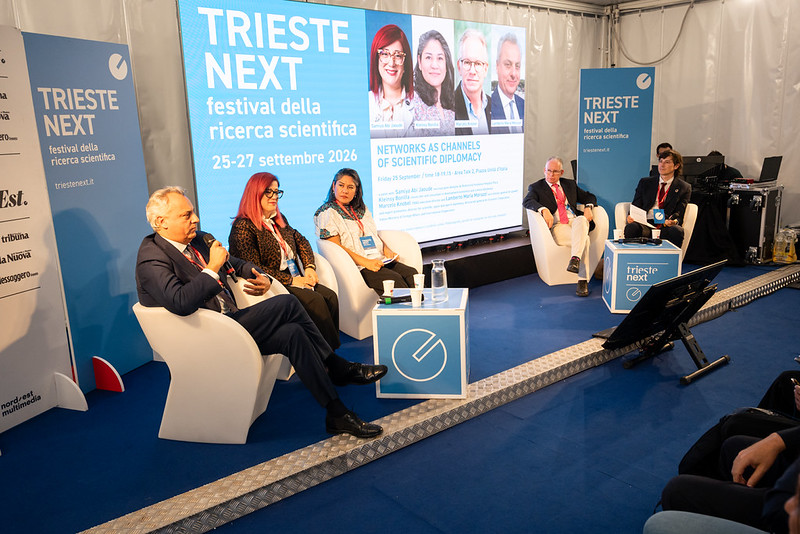
The 2026 edition of Trieste Next hosted a TWAS-IAP-OWSD round table titled ‘Networks as Channels of Scientific Diplomacy’ on 25 September 2026. The event brought together four strong voices from the world of science policy to discuss how scientific networks build trust and foster cooperation across boundaries.
TWAS executive director Marcelo Knobel opened the session, stressing the role TWAS, IAP and OWSD play in connecting researchers across the global South and North.
“We need to understand that we are facing a clear demographic change, and it is a strategic idea to develop. We must be in touch, we must collaborate all over the world on an equal basis in order to have a future,” he said.
Former OWSD vice president for Latin America and the Caribbean Kleinsy Bonilla, a Guatemalan researcher and consultant in development economics and science diplomacy, spoke about a career that has taken her from her native Guatemala to South Korea, Chile, Brazil, Iceland and now Norway.
“I have seen how much can happen when individual efforts become a collective approach,” she said. She highlighted the importance of networks such as OWSD at the global level, DiploCientífica in Latin America and the Caribbean, and RedCTi in Guatemala in connecting scientists, diasporas and policymakers.
“Networks linking the global South and the global North must also address power imbalances. Too often, some countries set the agenda while others simply take it. Science diplomacy is about changing that,” she added.
IAP Young Physician Leaders alumna Samiya Abi Jaoudé, a neurosurgeon at the Adolphe de Rothschild Foundation Hospital in Paris, drew on her work between Lebanon, France and Rwanda. She argued that networks become real channels of diplomacy only when they are built on trust, reciprocity and inclusion.
“The diaspora should not be a one-way channel through which knowledge flows from better-resourced countries to less-resourced ones. A bridge must work in both directions,” she said.
“Inclusion is not simply about inviting people into the room. It is about ensuring that they can influence priorities, participate in decision-making, and lead.”
Lamberto Maria Moruzzi, vice director general for growth and export promotion and director for scientific, space and sports diplomacy at the Italian Ministry of Foreign Affairs and International Cooperation, presented a diplomat’s point of view. By describing diplomacy as “the art of avoiding wars” he underlined that “as diplomats, we try to face differences through peaceful means.”
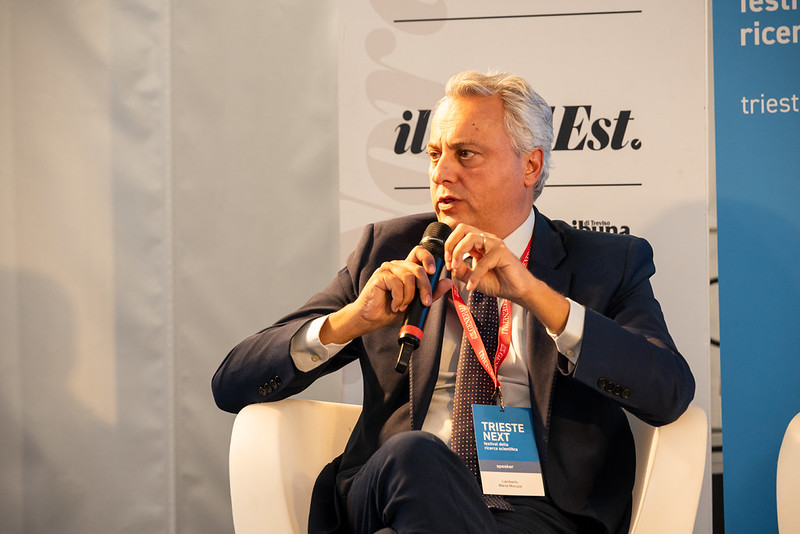
“Today, professional diplomats must understand science and technology, and work with it and for it,” he said.
Nowadays science diplomacy is a fundamental tool for foreign policy. It’s about bilateral relations, but also works through multilateral channels, Moruzzi noted, and Trieste is a great example. “Here in Trieste, you have an extremely relevant number of international organisations and activities concentrated in this city, which belong to the environment of science diplomacy, with a strong focus on the global South.”
The full recording of the panel is available here:
Alongside the round table, TWAS brought science photography to the festival with an exhibition at the Civic Art Gallery in Piazza Unità d’Italia. At its centre is Planting Water by Peruvian photographer Musuk Nolte, the winning essay of the first edition of the Through Southern Lenses: Science in Focus award.
Planting Water follows communities in the Peruvian Andes whose ancestral practices have enabled them to ‘plant’ water by restoring ancient hydraulic systems and working with the landscape rather than against it. Nolte’s photographs reveal that environmental understanding is preserved not only through scientific inquiry but through memory, tradition, and lived experience.
Through Southern Lenses: Science in Focus is an annual international photography award that celebrates scientific excellence across the developing world through the power of photography. The initiative is a collaboration between the Conrado Wessel Foundation and TWAS.
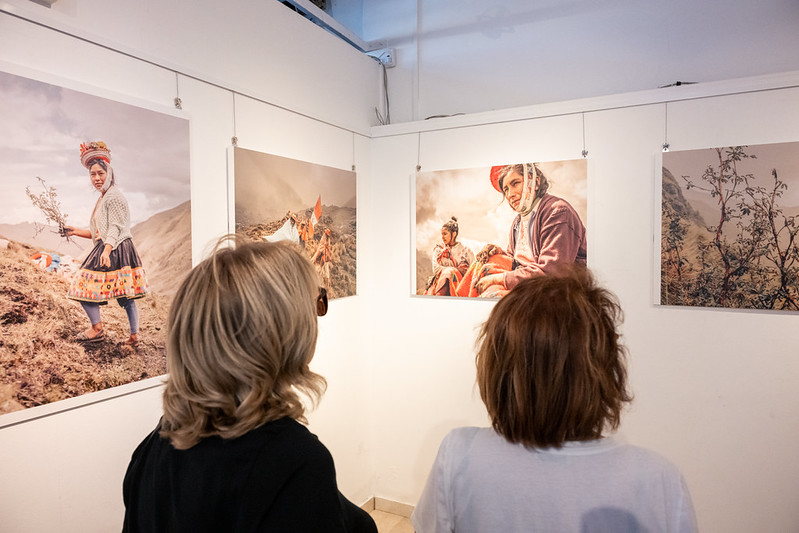
The exhibition in Trieste, supported by BCC Venezia Giulia, brings together Nolte’s photographic essay on water access and climate adaptation in the Peruvian Andes with a selection of photographs from the TWAS archives. Together, these works explore the connections between scientific research, local knowledge and environmental resilience.
On 25 September, the day of the round table, Kleinsy Bonilla and Samiya Abi Jaoudé also met local school pupils at the ICTP-TWAS-IAP-OWSD booth. They shared their experiences as women in science and talked about their careers across different countries, and about what it takes to build a life in research.
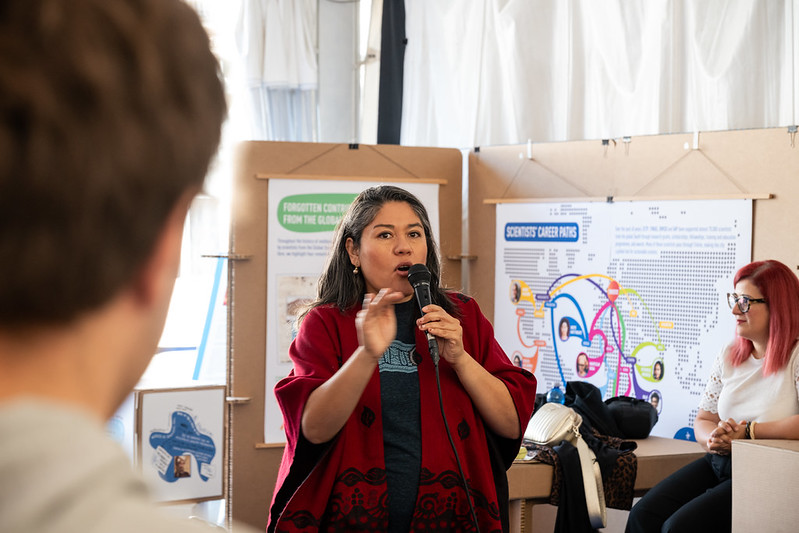
(Photo: G. Ortolani/TWAS)
More photos are available on the TWAS Flickr page. Quotes have been edited for length and clarity.
Giovanni Ortolani