


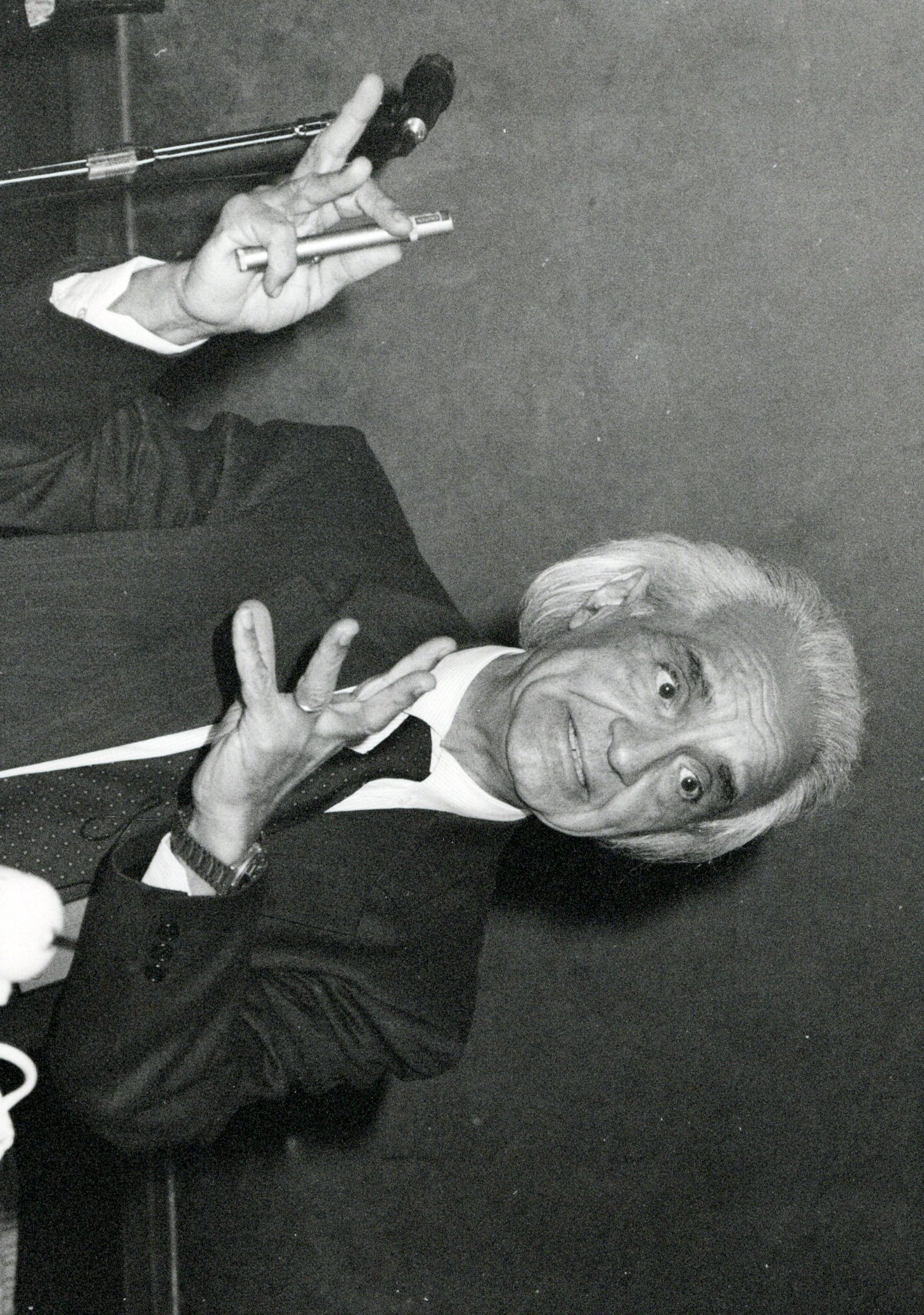
Antonino Zichichi, an emeritus professor of advanced physics at the University of Bologna, and a TWAS Fellow since 1986, passed away on 9 February 2026, at the age of 96. Zichichi was a leading Italian figure in high energy physics. He carried out part of his early scientific work at Fermilab in Chicago and at CERN in Geneva.
In 1963, he founded the Ettore Majorana Centre for Scientific Culture, in Erice, Italy, and in 1965 he led the research group that made the fist-ever observation of the antideuteron—a form of antimatter composed of an antiproton and an antineutron. From 1977 to 1982, during his presidency of the Italian National Institute for Nuclear Physics (INFN), he conceived the INFN Gran Sasso National Laboratories, located below the rocky Gran Sasso massif in Italy.
In 1982, he promoted the Erice Declaration for Peace. Starting in 1986, he was president of the World Lab, an organization supporting scientific projects in developing countries. He also chaired the NATO Committee on Disarmament Technologies and represented the European Community in the Scientific Committee of the International Science and Technology Center in Moscow. Among his scientific achievements is the production of pairs of heavy mesons with positive and negative strangeness.
His contribution to the Academy’s success has been considerable.
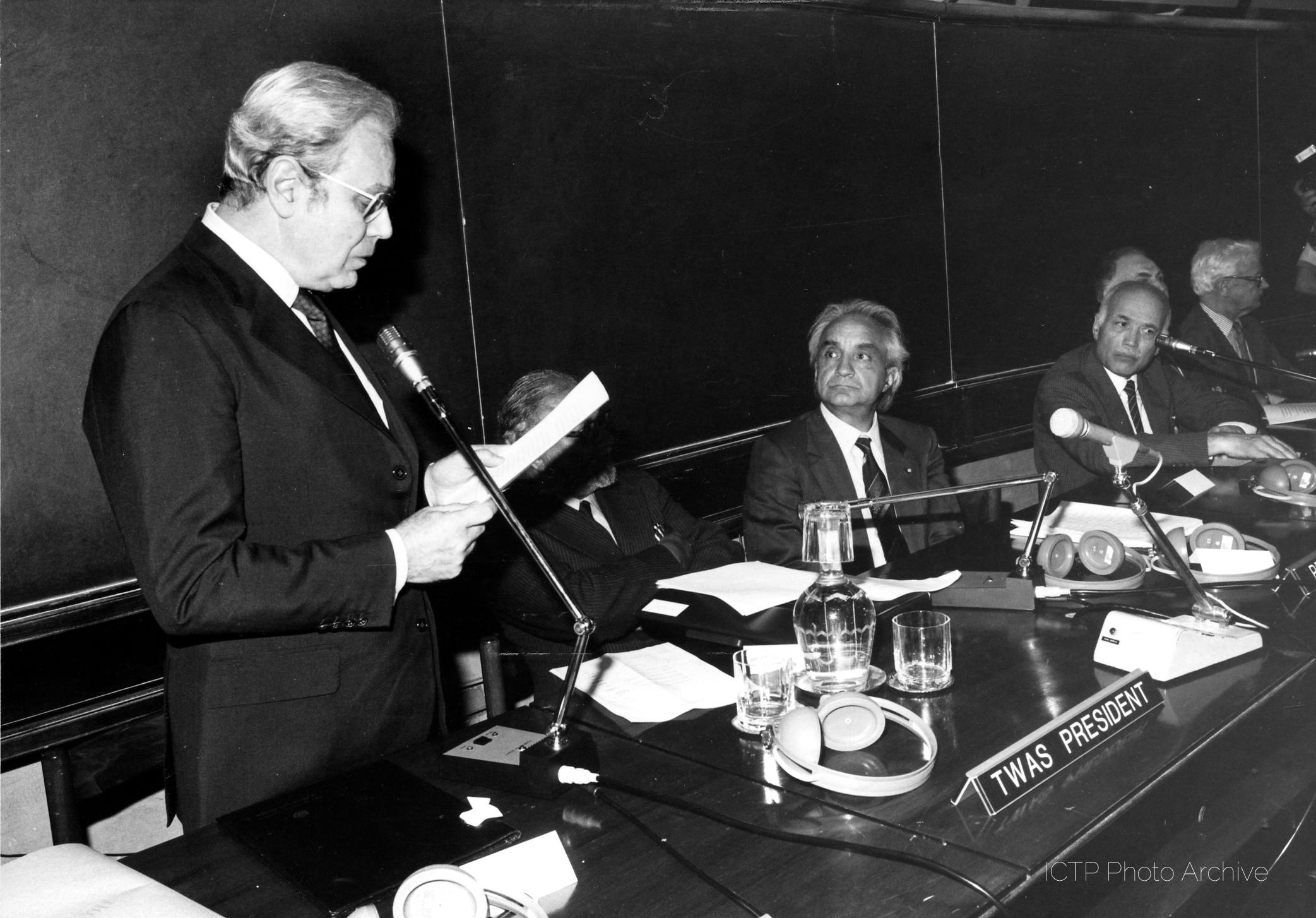
As former TWAS Executive Director Romain Murenzi said, none of the targets that the Academy hit would have been attained without Paolo Budinich and Antonino Zichichi’s vigorous action in early years. The two physicists, both TWAS Fellows, were instrumental in connecting the early Trieste System to Rome and in building science in developing countries. As a proof of the tight link with the Academy, Zichichi also invited TWAS representatives to the 44th session of the Erice International Seminars on Planetary Emergencies held in Erice, Italy, from 19 to 24 August 2011.
Zichichi authored more than 1,100 scientific papers, made seven discoveries, created five inventions, and had three original ideas that opened new directions in high energy subnuclear physics, in addition to four high precision measurements of fundamental physical properties.
The major projects of European physics—Large Electron-Positron and Lepton Asymmetry Analyser at CERN, the Gran Sasso Laboratories at INFN, and Hadron–Electron Ring Accelerator at the Deutsches Elektronen‑Synchrotron—are closely associated with his name, thanks to his seminal contributions to their conception, development, and implementation.
Cristina Serra