

2025: A year of strengthening STI partnerships towards sustainable futures for all
By TWAS President, Quarraisha Abdool Karim
A quarter century has passed since we moved into the new millennium, and in that time, TWAS has also moved forward—welcoming 1,288 new Fellows, digitizing much of its infrastructure, solidifying its seat in global science, collaborating with new partners, and providing new perspectives on key issues such as science diplomacy, climate change, pandemic preparedness, food security, artificial intelligence, and inequality.
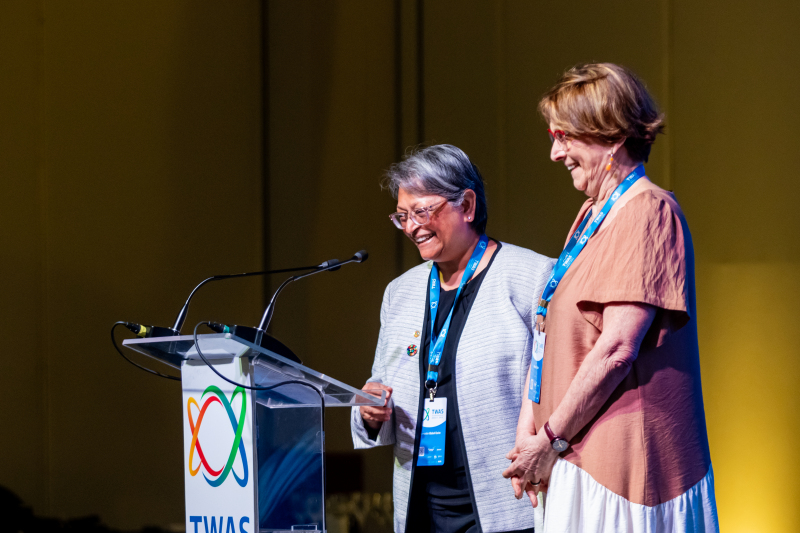
In 2025, in partnership with the Brazilian Academy of Sciences, TWAS celebrated the first in-person TWAS General Conference in seven years with the theme: ‘Building a Sustainable Future: The Role of Science, Technology, and Innovation for Global Development’. The Conference is usually hosted every other year and is an important venue for Fellows and Young Affiliates to gather, network, renew old friendships and make new ones. Our attendees get to tackle new and long-standing challenges as well as explore new opportunities to partner and collaborate.
The 2025 Conference was attended by about 300 TWAS Fellows, Young Affiliates, the Secretariat, high-level government officials, experts, and science journalists. Together, they discussed through plenary talks, panel discussions and during breaks how science can be used to accelerate progress on sustainable development, including issues relating to food security; health, gender, pandemic prevention and preparedness responses; science diplomacy; professional ethics; and the promise and perils of artificial intelligence. Importantly it was a moment to celebrate and welcome new Fellows and be inspired by our award recipients.
The Conference opened with an inspiring and rousing opening ceremony that included a special message from Brazil’s President Luiz Inácio Lula da Silva, underscoring that now more than ever the powerful combination of innovation, capacity building and training and solidarity are key to a more just, sustainable, and multipolar world. Also included in the programme was a keynote address by Guatemalan Vice-President Karin Herrera, who detailed her country’s efforts to spur scientific growth. We also heard stirring lectures from Luiz Davidovich who won the prestigious TWAS Apex Award, and Moazzum Bajwa, TWAS Founder Abdus Salam’s grandson and an expert in family medicine, who detailed how TWAS continues to embody his grandfather’s mission four decades after its founding.
TWAS Young Affiliates assured us that our future is in good hands through their commendable ‘flash talks’ and paired poster sessions. A new TWAS strategy of a ‘womenonly’ year every three years for new Fellows was presented and adopted to accelerate progress on closing gender gaps. We celebrated the 40th anniversary of TWAS and launched a coffee-table book that captures key moments and milestones in TWAS’s journey to date.
At this consequential, complex and unprecedented juncture, the centrality and critical role of partnerships and science and innovation to tackle converging complex challenges brought hope to participants. These include long-standing and deeply valued partnerships with the Italian government through its Ministry of Foreign Affairs and International Cooperation (MAECI), the Italian Agency for Development Cooperation (AICS), the Friuli Venezia Giulia region (FVG), and the institutions under the umbrella of the Friuli Venezia Giulia Scientific and Innovation System (SiS FVG). TWAS participation in the Science for Society Annual Forum in Kyoto; the annual Big Data for Sustainable Development Forum in Beijing; the World Science Forum in Budapest; the UNESCO International Decade of Science for Sustainable Development; and more, reinforce TWAS’s deep roots in the country, region and world and are connections that are vital for our mission.
We thank the German Federal Ministry of Research, Technology and Space of Germany (BMFTR), the German Research Foundation (DFG), the Swedish International Development Cooperation Agency (Sida), the Elsevier Foundation, the David and Lucile Packard Foundation and the American Association for the Advancement of Science (AAAS); the Abdus Salam International Centre for Theoretical Physics (ICTP), the Organization for Women in Science for the Developing World (OWSD) and the InterAcademy Partnership (IAP).
The national governments of Brazil, China, and Chile are setting new models for country-level commitments complemented by our five Regional Partners, who keep TWAS closely connected to Fellows and local challenges in different regions of the developing world. The TWAS Young Affiliates Network (TYAN), brings fresh energy to the Academy by fostering links among early-career scientists and promoting international collaboration.
These accomplishments are possible through the engagement of the TWAS Council and TWAS Fellows, who continue to generously serve on committees; represent TWAS at key meetings and conferences and actively participate in nominating new Fellows. In 2025, we welcomed 63 new Fellows, including 23 women across 10 subject categories to TWAS. These outstanding scientists represent excellence in innovation primarily from the global South and TWAS-identified Science- and Technology-Lagging Countries (STLCs).
Also importantly, TWAS programmes disbursed 68 research grants, and 19 TWAS-supported doctoral students graduated from across the global South, including 11 from STLCs and six from UN-identified Least Developed Countries (LDCs). One notable programme, designed to facilitate North- South research links, is the TWAS-SISSA-Lincei Research Cooperation Visits Programme. In May 2025, six early-career scientists from Bangladesh, Madagascar, Nepal, Niger, and Rwanda, visited the TWAS headquarters in Trieste with their supervisors, and shared key findings from their research with Italian collaborators.
In partnership with AAAS, TWAS hosted the 12th Course on Science Diplomacy, a highly sought-after and competitive event for emerging science leaders. Selected candidates attended the course in ‘participant pairs’—one early-career scientist and one policymaker each typically from the same country—to enhance understanding of the theory and practice underpinning science diplomacy and to validate tools that are important in its application.
This is just a tantalising preview of the accomplishments profiled in this Annual Report. We count on and deeply value your active engagement and partnership as we continue to advance the vision of the TWAS Founding Fellows and partners of using science, technology and innovation to benefit and enhance the lives of everyone, everywhere including the global South.
Read the full Annual Report 2025, available now online.